


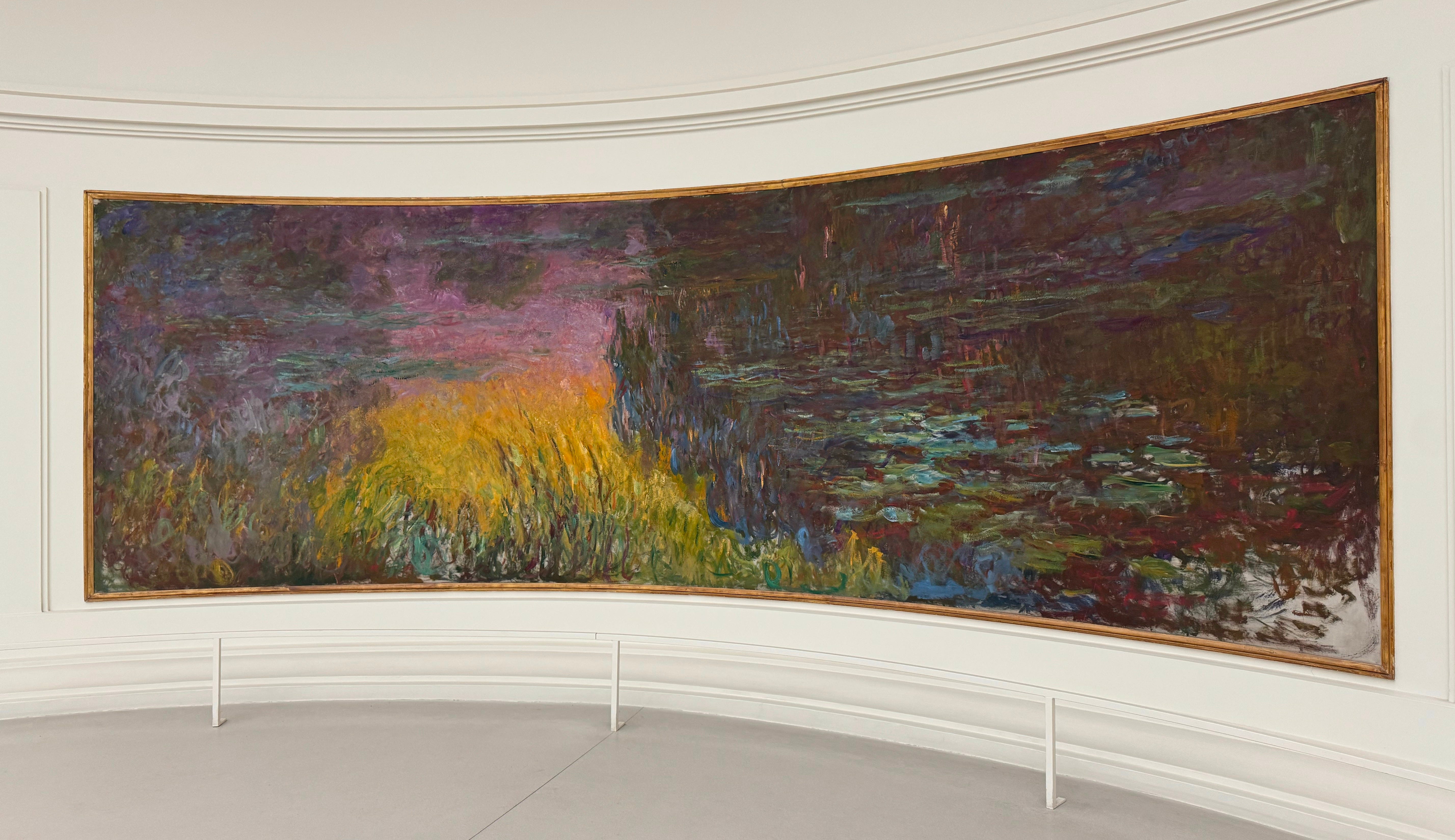
On a balmy afternoon in mid-May, I stood still in the Musée de l’Orangerie. I slowed my breath and took in an expanse of lilac, mauve, and mist.
Monet designed these rooms specifically as a space for meditation, and I wanted to take that seriously. His series of Water Lilies stretch across giant curved walls that envelop you; the scale and curved walls transform the panels into something far beyond traditional painting. Up close, each painting dissolves into pure abstraction as brushstrokes become currents of color and forms that seem to float somewhere between vision and memory. Kind of like the way light lingers in the eye after you look away. They ask you to feel what it is to see.
It’s almost too obvious, some might say, bordering on cliché, to love Monet. Among artists and critics, his popularity can be dismissed as safe or middlebrow, the appeal of his art too obvious to warrant deeper attention. But I think that’s exactly why it’s worth pausing.
Generation after generation, what is it that keeps drawing us to Monet? I don’t believe it's just surface beauty. Instead, I think he managed to paint something much more enduring and difficult—the very act of perception itself. The tremble of light and feeling, the impossibility of holding either for long.
What was Monet trying to preserve in those final paintings at Giverny? The flicker of a moment? The liminal space of memory?
EXTRACTING MEMORIES
John Berger, the art critic thought so. In his essay The Eyes of Claude Monet¹, he argues that Impressionism did far more than romanticize color and light. It found a way to sever the viewer from the illusion of permanence.
Impressionist paintings do not offer entry into a stable world the way a Caravaggio or Vermeer might. Berger writes: “You cannot enter an Impressionist painting; instead it extracts your memories.”
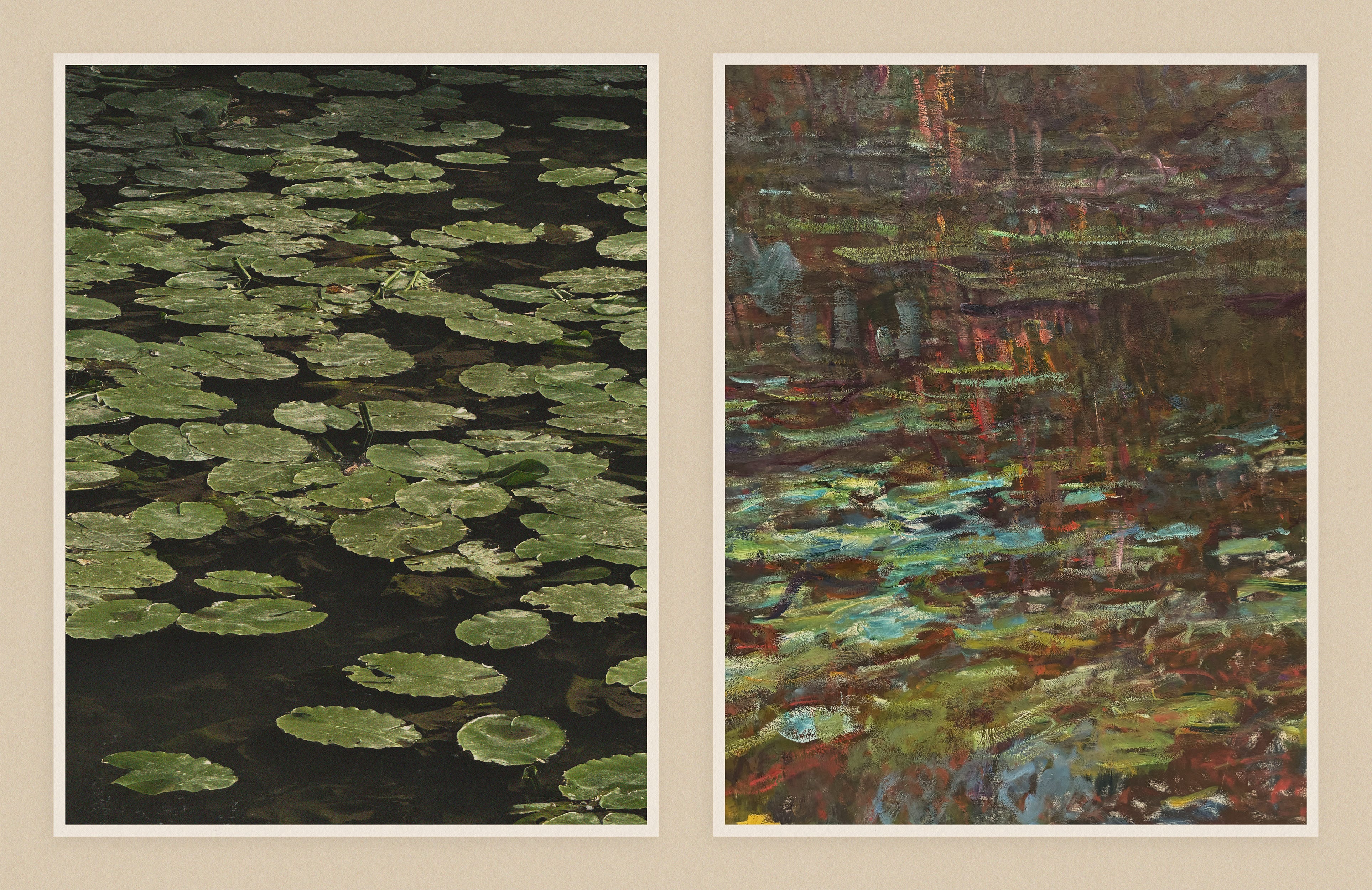
This felt especially true during my recent visit to France. The day after I visited the galleries of Water Lilies at the l'Orangerie, I took the train out to Giverny and walked through Monet’s gardens. Standing by the famous pond, I squinted to blur my vision, letting the canvases resurface in memory and transpose themselves onto the scene before me.
His paintings were no longer just representations; they were lenses. A way to see how Monet had shaped both the world he lived in and the world he painted.
I took a quick moment to paint a watercolor in my sketchbook, feeling slightly cliché as I did it. But the earnest attempt to capture what I was seeing gave me infinitely more appreciation for Monet’s ability to translate that shifting, affective, and ephemeral quality of beauty and atmosphere into paint.
WHEN SCIENCE MEETS INTUITION
Berger’s reading of Monet resists over-sentimentality and describes how these paintings provoke memory without accusing them of nostalgia. Writing on Monet’s painting of a lilac tree on a sunny day:
“Given the precision and the vagueness, you are forced to re-see the lilacs of your own experience. The precision triggers your visual memory, while the vagueness welcomes and accommodates your memory when it comes. More than that, the uncovered memory of your sense of sight is so acutely evoked that other appropriate memories of other senses—scent, warmth, dampness, the texture of a dress, the length of an afternoon—are also extracted from the past.”
This all sounds poetic and intuitive from an art critic, but contemporary science actually has a lot to say as well about how Monet’s paintings work in the brain.
For this, we turn to the growing field of neuroaesthetics that over the previous couple of decades has begun to offer a new vocabulary for what happens when we experience beauty. Researchers such as Semir Zeki² and Anjan Chatterjee³ have found that certain visual qualities such as softness, ambiguity, and low spatial frequency can engage our brains differently than precise realism.
Beyond just the visual cortex, these qualities also activate areas associated with memory and self-referential processing.
In a pivotal 2012 study⁴, Edward Vessel and colleagues found that when people viewed artworks they found personally moving, their brains showed increased activation in the medial prefrontal cortex, posterior cingulate cortex, and angular gyrus. These are key regions of the default mode network, which is involved in autobiographical memory and internal meaning-making.
More recent research⁵ by Oshin Vartanian and colleagues builds on this work, finding that artworks with visual ambiguity (those that don’t resolve clearly or immediately) elicit stronger individual interpretation and emotional resonance. This supports the idea that paintings like Monet’s, with their blurred edges and indefinite forms, prompt the viewer’s brain to complete the image through personal experience.
Berger’s intuition holds up remarkably well. Monet’s paintings function less as windows and more as mirrors that reflect not only our external world but also the inner life of the person standing before them.
THE BODY THAT SEES
French philosopher Maurice Merleau-Ponty⁶ suggested the act of creating art is always embodied, and quoted Paul Valéry saying that the painter “takes his body with him.” The artist brings their full physical and experiential self to the canvas. Not just their eye or technical capacities, but their entire lived experience. As does the viewer, we observe through the full weight of our experiences, emotions, and memories.
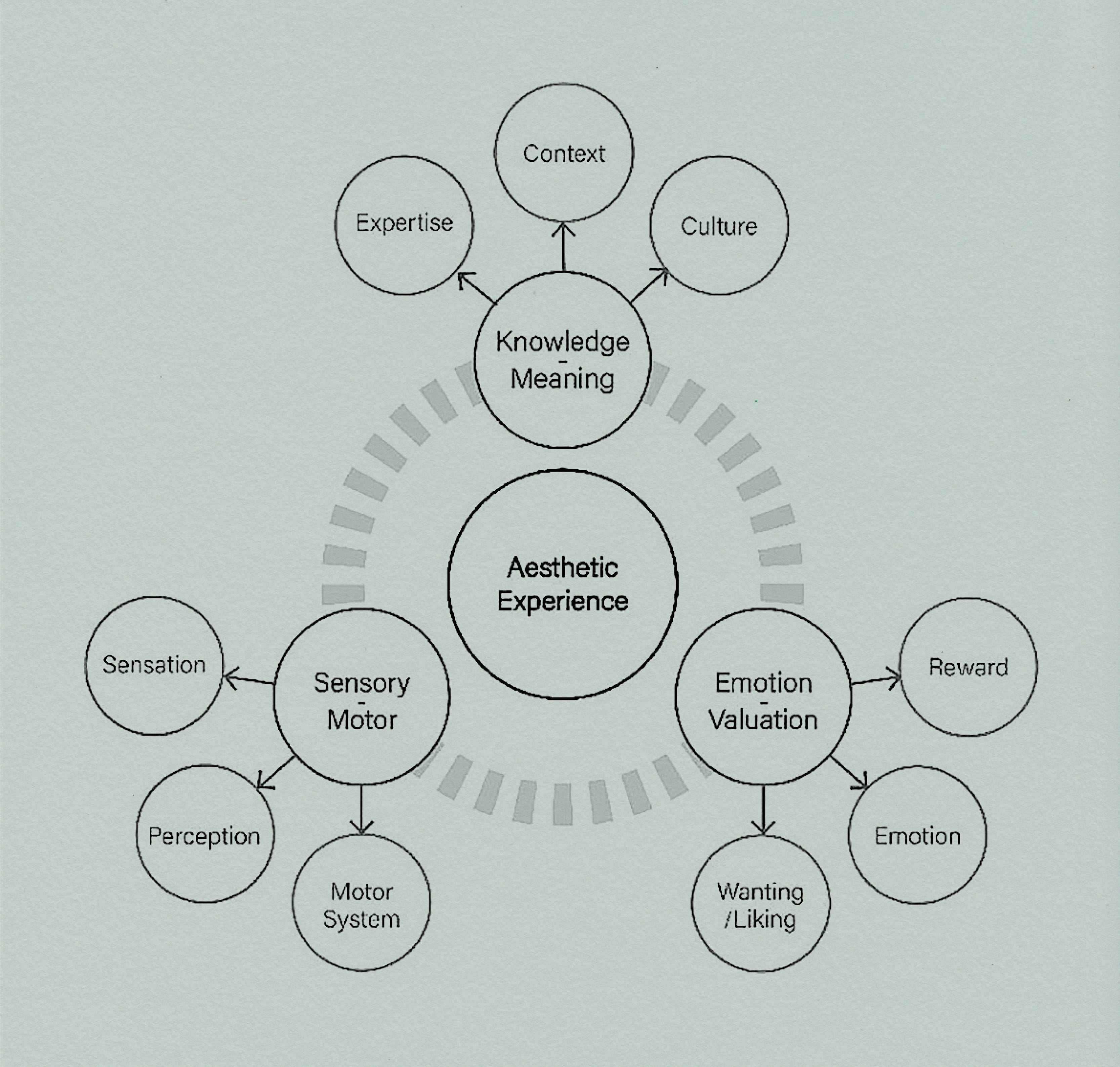
This intuition about embodied creation and perception has found remarkable validation in contemporary neuroscience. Researchers now recognize what they named “The Aesthetic Triad,”³ where our sensory-motor, emotion-valuation, and meaning-knowledge systems work together to create our experience of beauty and meaning. (See diagram above.)
Psychologist Lisa Feldman Barrett⁷ expands this idea further with her theory of constructed emotion, which suggests that emotions themselves are not fixed reactions but rather mental events created by interpreting bodily sensations in context. The brain reads an internal signal such as a racing heart or a tight stomach and categorizes and contextualizes it in our prior experiences and situational cues to form what we recognize as emotion.
So when you stand before Monet’s lilies, far beyond shape and color, your brain is building a layered, emotionally charged moment from perception, memory, and embodied meaning.
The painting becomes a co-created experience.
WHAT EXISTS BETWEEN
Monet returned again and again to his gardens at Giverny in his final decades. Even as cataracts began to cloud his vision and soften the contours of color, his work turned inward. It became less about what he saw and more about playing with perception and memory. The lilies blur into mist and sky and water melt together just as time stretches and folds.
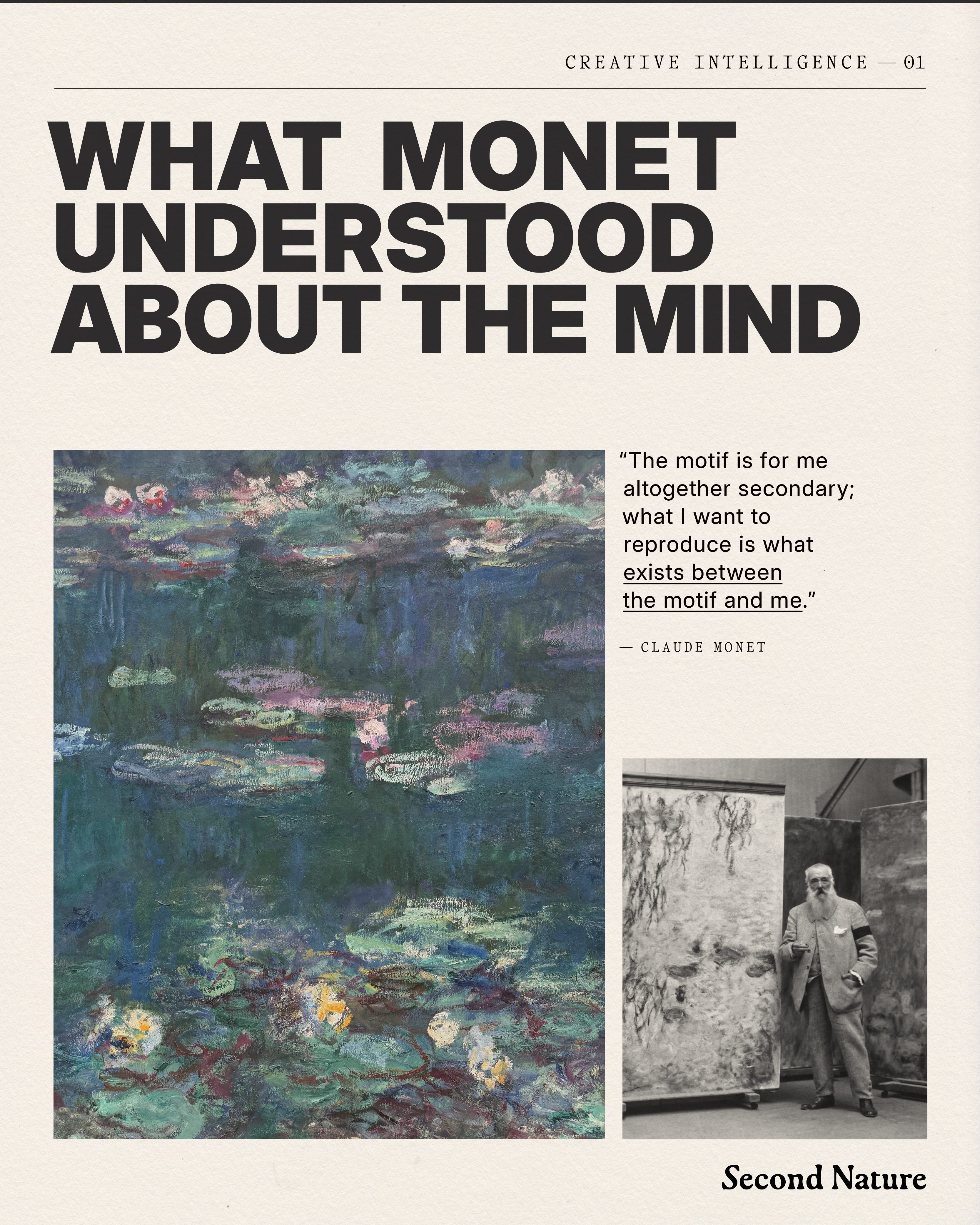
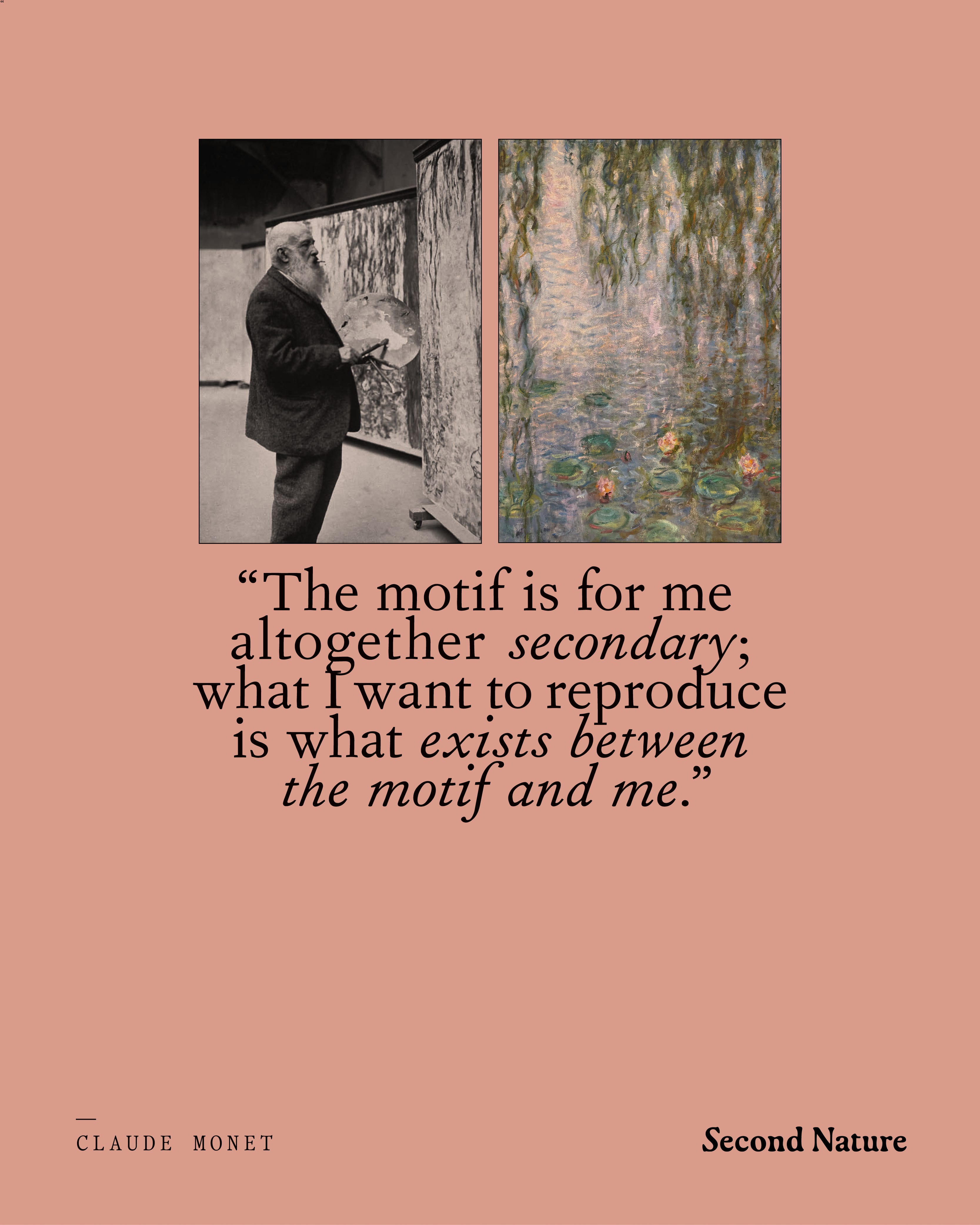
During an 1895 interview, Monet expressed, “the motif is for me altogether secondary; what I want to reproduce is what exists between the motif and me.”
He was so far ahead of his time and now, if we follow the science, we can see that what exists in this space is far from empty. It is rich with our autobiographical memories, evolving emotional construction, and our embodied responses. It is where the viewer lives.
When we look at Monet’s work, it becomes an act of completion. And in this completion, we discover something about the nature of perception itself: that seeing is never passive, never objective, and always a creative act of construction between the world and the self.
So perhaps Monet’s Water Lilies were never simply about a beautiful garden. And instead they were, as Berger wrote, “a pond that remembered all.” Not because the flowers were there, but because we were.
What do you see when you look at a Monet?
I’d love to hear about times when art has stirred something unexpected in you.
REFERENCES
Berger, J. (1980). The Eyes of Claude Monet. In J. Berger, Towards a Small Theory of the Visible, pp. 53–65. Penguin UK.
Kawabata, H., & Zeki, S. (2004). Neural correlates of beauty. Journal of neurophysiology, 91(4), 1699-1705. https://doi.org/10.1152/jn.00696.2003
Chatterjee, A., & Vartanian, O. (2014). Neuroaesthetics. Trends in cognitive sciences, 18(7), 370-375. https://doi.org/10.1016/j.tics.2014.03.003
Vessel, E. A., Starr, G. G., & Rubin, N. (2012). The brain on art: Intense aesthetic experience activates the default mode network. Proceedings of the National Academy of Sciences, 109(28), 10446–10451. https://doi.org/10.1073/pnas.1205271109
Vartanian, O., Lam, J., Kwantes, P. J., & Martindale, C. (2023). The aesthetics of ambiguity: Beauty and indeterminacy in the brain. Neuroscience & Biobehavioral Reviews, 149, 105231. https://doi.org/10.1016/j.neubiorev.2023.105231
Merleau-Ponty, M. (1964). Eye and mind. In M. Merleau-Ponty, The Primacy of Perception. Northwestern University Press.
Barrett, L. F. (2017). How Emotions are Made: The Secret Life of the Brain. Houghton Mifflin Harcourt.
The best read I’ve ever experienced on substack!
so fascinating 💓