


Hello! 🇫🇷 I’m recently back from Paris, where I attended and presented at the Society for the Neuroscience of Creativity’s international conference at the Sorbonne. The world’s leading creativity researchers and neuroscientists gathered to share their latest findings, and I want to start with a juicy topic: Creativity and AI. An entire day was dedicated to this subject as researchers grappled (like the rest of us) with fundamental questions around the future of human creativity in an AI-saturated world.
This digest covers the latest insights on creativity and AI—originally just conference highlights, I’ve now expanded to include other emerging research that’s too important to ignore. I’m keeping my opinions to a minimum and focusing on digestible takeaways to inform your own creative practices and perspectives. I hope you find this helpful!
OK! Let’s get started…
THE HIDDEN COST OF MENTAL SHORTCUTS
One of the most impactful studies at the conference came from neuroscientist John Gero of UNC Charlotte, who presented¹ brain imaging results from people working on creative engineering problems. Some participants used AI assistance while others worked without it. Using fNIRS (a brain imaging technique that tracks neural activity by measuring blood oxygen changes), he monitored participants’ brain activity throughout these tasks.
What his team found was eye-opening: people using AI showed dramatically lower brain activity compared to those working without it. He found reduced activation across regions tied to working memory and cognitive control. In other words, the AI users’ brains were barely engaged.
Gero referenced Socrates’ ancient complaint that writing ideas down would turn his students’ brains to mush, suggesting: “Either AI is going to take over all cognitive tasks and we won’t have to think, or this gives us cognitive surplus to do other things.”
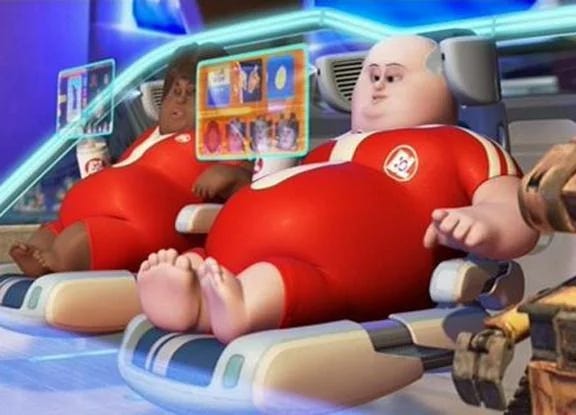
A crucial reminder that while AI can lighten our cognitive load, we risk mental atrophy if we lean on it too heavily. (This always makes me think of the film WALL-E.)

On similar note… in a MUCH buzzed about new pre-print paper²… MIT researchers found similar results in a 4-month-long study examining the neural-patterns of AI-use and writing.
They used EEG sensors (another brain-monitoring technique) to track alpha waves (creative processing) and beta waves (active thinking) while students wrote essays over four sessions. Some groups used ChatGPT from the start, while others worked without any AI assistance for the first three sessions.
While ChatGPT users completed essays 60% faster, their brains showed up to 55% less connectivity (!!!) in neural networks needed for complex thinking, particularly in alpha, theta, and delta frequency bands. These chronic AI users also didn’t feel a sense of ownership over their work and couldn’t recall what they had written. In one session, 83% couldn’t accurately quote from their own essay. The people using AI weren’t mentally encoding what they had “written.”
The concerning pattern continues… the essays themselves became eerily similar. The ChatGPT group produced highly homogeneous content within each topic, while the brain-only group maintained more diverse, varied, and creative approaches. Even teachers could detect the AI-influenced writing patterns and scored those essays lower for originality.
Then, something really interesting happened in the final session. The researchers had the no-AI group suddenly use ChatGPT for the first time, while the chronic AI users had to work completely alone. The no-AI-until-the-end group showed robust neural networks and stronger performance when AI was introduced. Meanwhile, when chronic AI users lost their digital support, they performed poorly with reduced alpha/beta brain activity and poor content recall. The AI-dependent group had actually gotten worse at the core task over time.
TL;DR: AI isn’t all bad, but your productivity boost can come with hidden costs when you skip the foundation-building phase. The researchers call this phenomenon “cognitive debt.” There are real long-term costs of repeatedly offloading mental effort to AI systems. It’s best to develop your deep thinking skills first—then use AI to amplify them—rather than letting AI do the thinking for you.
AI-COACHING vs. AI-CREATING
Before we panic about AI rotting our brains, AI can actually enhance our creativity if we take a very different approach. Instead of having AI generate ideas for you, try having it coach you on your own ideas.
Researchers tested this in two recent studies³. In one, 554 adults tackled design problems while receiving real-time AI feedback on their solutions. In another, over 36,000 museum visitors completed drawings with AI coaching their creative process.
The results were pretty amazing. People who received AI feedback on their own creative work not only produced 35-43% more original outputs immediately, but their creative evaluation skills also improved for future unassisted work.
This coaching approach helps preserve what psychologists call “cognitive agency,” or your sense of ownership over the creative process. When AI generates for you, that ownership fractures. When AI helps you refine your own thinking, it strengthens.
NEXT TIME YOU USE AI: Instead of asking AI to write your first draft, write it yourself and ask AI to identify weak spots, suggest alternative approaches, or help you evaluate multiple options you’ve generated. Let AI coach you in building your creative muscle instead of bypassing it.
THE EXPERTISE PARADOX
Did you know your skill level completely changes how you should use AI?
Penn State researcher, Paul V. DiStefano, presented⁴ work comparing engineering students (experts) with psychology students (domain novices) on engineering design challenges. Both groups improved with AI help, but they used AI suggestions in very different ways. The novices directly adopted AI’s ideas without questioning them, while the experts were more likely to reject AI suggestions or spin off ideas into entirely new concepts.
This expert resistance can actually enhance creativity. Research has shown that using AI as “counter-inspiration” (using AI suggestions as a springboard to develop opposite or alternative ideas) can improve creativity.⁵ However, this requires the cognitive effort and creative confidence that developing expertise naturally builds. More generally, AI may be most helpful for less creative individuals, essentially democratizing creativity by lifting baseline abilities. What some call a “rising tides lift all boats” effect, while having minimal impact on improving already highly creative people.⁶
But expert resistance to AI suggestions can also have a downside. If taken too far, you could miss valuable insight due to hubris. Austrian researchers⁷ found teams using ChatGPT rejected 59% of AI suggestions due to systematic bias against algorithmic output. Unfortunate for the rejecting teams, the groups that used more AI ideas performed better; it was human judgment that prevented people from benefiting from AI collaboration.
CONSIDER YOUR SKILL-LEVEL: The expertise effect works both ways—domain experts can better evaluate which AI suggestions to use, but they’re also more resistant to AI help. Novices benefit more from AI but risk becoming overly dependent on it. If you’re already skilled in a particular task, use your judgment to cherry-pick AI suggestions while maintaining independence. If you’re still developing skills, AI can accelerate your progress, but be intentional about building critical thinking skills rather than defaulting to AI dependency.
WHO’S A BETTER COLLABORATOR?
As anyone who works in an office or team knows, creativity is very rarely a solo activity. So what happens when we compare AI-collaborators to purely human creative partnerships?
A group of researchers⁸ compared human-human partners with various AI partnerships across multiple creativity tasks. Human pairs consistently outperformed all AI conditions. Not only did they produce more creative responses, but they were also the only group to show increased creative confidence after collaborating.
The AI tools felt easier to work with and less cognitively demanding. But that ease didn’t translate to better creative outcomes. Most truly creative ideas require some mental effort, so when AI removes that friction, you lose access to the deeper insights and breakthroughs that come from working through complex problems yourself.
Even more concerning: when AI judges evaluated the human and AI outputs, they favored AI-assisted responses. This may be because AI tools generate longer, more detailed responses that appear more creative to automated systems but aren’t necessarily more innovative. It’s something to keep in mind when asking ChatGPT or Claude to give you feedback; they’ll prefer their own writing to yours!
HUMANS > AI PARTNERS: AI can’t (yet) replace the value of collaborating with another living breathing human. For genuine originality and breakthrough thinking, we need to prioritize human collaboration. The unique dynamic of human-human creative partnership builds both better ideas and the creative confidence needed for future innovation.
A COLLECTIVE CREATIVITY CRISIS
Ok, so we’ve seen the risks and benefits of individual and team collaboration with AI, but I’m sorry to report there’s a darker story emerging about what is happening to our greater collective imagination.
AI is making our thinking less diverse.
UPenn researchers⁹ have discovered what they call the “sprinkler effect.” When people used ChatGPT for brainstorming, their ideas clustered around extremely similar concepts. Picture two brainstorming sessions for repurposing (A) a tennis racket and (B) a garden hose:
Session A responses: “Garden furniture, Storage rack, Picture mount”
Session B responses: “Lawn sprinkler, Water sprinkler, Garden sprinkler”
Session A shows 100% unique ideas, while Session B has one unique idea with three micro-variations. This clustering in B demonstrates how AI can reduce creative diversity even when each individual response can seem innovative. In the real study, 20 out of 96 AI-aided ideas mentioned “sprinkler” compared to just 7 from participants who could use web searching and 12 from human-only brainstorming.
This “sprinkler effect” goes back to how AI fundamentally works. Large language models learn by identifying patterns in massive datasets of human writing. They excel at predicting what comes next based on what’s most common. This inherently pushes responses toward the statistical center rather than the creative edges. You’ve probably already started noticing this in your daily life. Social media posts, marketing copy, and professional emails are increasingly sharing similar structures and rhythms and using oddly similar language. This is the fingerprint of AI-assisted writing converging on statistical averages, and it’s reshaping our collective creative landscape in real time. It’s even training us to talk and write like AI, even when we aren’t using it.¹⁰ You can imagine how this will eventually affect our offline creative thinking, too.
SET AI BOUNDARIES: Protect creative diversity by establishing “AI-free zones” in your creative process. Start brainstorming sessions without AI input, indulge in wild ideas before looking to AI for optimization, and actively seek out human perspectives for diversity and depth. Our collective imagination depends on preserving the statistical outliers that AI naturally filters out.
THE NEUROSCIENCE OF AI PARTNERSHIP
What struck me most about these findings wasn’t just the individual implications, but what they reveal collectively about the moment we’re living through. We’re rewiring fundamental neural pathways that have governed human creativity for millennia.
The prefrontal cortex, our executive control center, partially disengages when AI enters the creative process. The default mode network, which typically fires during imaginative thinking, shows altered patterns of activation. We’re conducting a real-time experiment on human consciousness, with every creative professional as both researcher and subject. Tread carefully.
I’LL LEAVE YOU WITH THIS…
After all the presentations, research papers, and conversations with creative friends, here is what I suggest for maintaining your creative vitality in this new AI era:
STAY COGNITIVELY ACTIVE.
Regularly work without AI assistance to keep your independent creative networks active. Use AI to handle routine tasks, but make sure you’re still exercising higher-order creative thinking. Repeated cognitive offloading creates a debt that has real consequences for your brain’s ability to handle complex work in the future.LEVERAGE YOUR EXPERTISE.
The more you know about your domain, the more powerfully you can direct AI collaboration. Deep knowledge built in the “real” world is your competitive advantage.NAVIGATE RELATIONSHIPS THOUGHTFULLY.
Expect your relationship with AI tools to be complex and evolving. Stay open! Friction and deep thinking are often what produce creative insights. But remember, your audience is human, so prioritize human feedback over AI’s aesthetic judgment when evaluating your work.
The neuroscience is clear: we’re in a transitional moment that requires intentionality. The creators who thrive will be those who learn to critically collaborate with artificial intelligence rather than be led by it. Do whatever you can to maintain your neural creative capacity while leveraging AI’s computational power to expand your reach.
We’re choosing what kind of creative minds we want to have in the future.
What has your experience been with AI in your creative practice? I’d love to hear how these findings resonate with your own observations. 🤖 👀
AND IF YOU’D REALLY LIKE TO GO DOWN THE RABBIT HOLE…
Aruon, A., Shealy, T., & Gero, J. (2025, May). Enhancing future-oriented thinking in engineering design through cognitive interventions and AI assistance. Symposium presentation at the Society for the Neuroscience of Creativity, AI, Creativity, and a Changing World Symposium, Paris, France.
Kosmyna, N., Hauptmann, E., Yuan, Y. T., Situ, J., Liao, X. H., Beresnitzky, A. V., ... & Maes, P. (2025). Your brain on ChatGPT: Accumulation of cognitive debt when using an AI assistant for essay writing task. arXiv preprint arXiv:2506.08872. https://arxiv.org/abs/2506.08872
de Chantal, P. L., Beaty, R., Laverghetta, A., Pronchick, J., Patterson, J., Organisciak, P., ... & Karwowski, M. (2025). Artificial intelligence enhances human creativity through real-time evaluative feedback. https://osf.io/qrgbn/
DiStefano, P. V., Zeitlen, D. C., Rafner, J., de Chantal, P. L., Peng, A., Miller, S., & Beaty, R. E. (2025, May). Evaluating AI's ideas: The roles of individual creativity and expertise in human-AI co-creativity. Symposium presentation at the Society for the Neuroscience of Creativity, AI, Creativity, and a Changing World Symposium, Paris, France.
Rafner, J., Zana, B., Hansen, I. B., Ceh, S., Sherson, J., Benedek, M., & Lebuda, I. (2025, May). Agentic perspective on human-AI collaboration for image generation and creative writing: Insights from think-aloud protocols. Symposium presentation at the Society for the Neuroscience of Creativity, AI, Creativity, and a Changing World Symposium, Paris, France. https://osf.io/4exwq_v1
Doshi, A. R., & Hauser, O. P. (2024). Generative AI enhances individual creativity but reduces the collective diversity of novel content. Science Advances, 10(28), eadn5290. https://www.science.org/doi/10.1126/sciadv.adn5290
Bangerl, M. M., Disch, L., David, T., & Pammer-Schindler, V. (2025, April). CreAItive collaboration? Users' misjudgment of AI-creativity affects their collaborative performance. In Proceedings of the 2025 CHI Conference on Human Factors in Computing Systems (pp. 1-17). https://doi.org/10.1145/3706598.3713886
Tang, M., Hofreiter, S., Werner, C. H., Zielińska, A., & Karwowski, M. (2024). "Who" is the best creative thinking partner? An experimental investigation of human–human, human–internet, and human–AI co‐creation. The Journal of Creative Behavior. https://doi.org/10.1002/jocb.1519
Meincke, L., Nave, G., & Terwiesch, C. (2025). ChatGPT decreases idea diversity in brainstorming. Nature human behaviour, 1-3. https://doi.org/10.1038/s41562-024-01953-1
Yakura, H., Lopez-Lopez, E., Brinkmann, L., Serna, I., Gupta, P., & Rahwan, I. (2024). Empirical evidence of large language model's influence on human spoken communication. arXiv preprint arXiv:2409.01754. https://arxiv.org/abs/2409.01754